Last year, I made a set of predictions about what influencer marketing would look like in 2025. Now that we’re officially here, it’s time to hold myself accountable and see where I nailed it, where I was mostly right, and where I need to give myself a gentle “nice try.”
Here’s my 2025 prediction report card:
Hyper-Specific Niches & Hyperlocal Campaigns
Grade: A
This one absolutely played out (at least here at Sway Group!). Brands continued to move away from broad, catch-all influencer strategies and leaned harder into creators with tightly defined audiences, whether that meant Twin City owners of fat orange cats, perimenopausal women who love snacking, or school employees in Washington state.
These campaigns are some of our favorites because they tap directly into what Sway Group does best: finding the exact right creators for even the most challenging, highly specific briefs. Hard-to-source recruits are where many agencies struggle, but they’re where we shine. And when you match a brand with a creator who truly lives the niche, you get content that feels unmistakably real.
Bottom line: Hyper-specific > hyper-scale.
Cross-Platform Posting Makes a Comeback
Grade: B
I predicted a broad resurgence of cross-platform posting, and while the idea came true, the execution looked a lot different than expected. Here’s what actually happened in 2025:
Cross-platform demand skyrocketed, but almost entirely between Instagram and TikTok. Clients consistently asked for the same content to live on both platforms, but interest in Pinterest, YouTube Shorts, newsletters, and other channels was far more limited than anticipated.
What also emerged (and what I didn’t predict strongly enough) was a growing tension around pricing. Many brands still expect cross-posting to be bundled into a single, low “one piece of content” rate. But for creators, posting to multiple platforms often means double the effort, double the reach, and double the cost.
The only time cross-posting gets offered as a value-add is when one of the platforms is dramatically smaller for that creator. Think a TikTok-first creator posting to a tiny Instagram audience or vice versa.
So yes, cross-platform posting is back and very much here to stay, but it’s happening in a narrower lane than expected, and with more pricing friction than the industry seems prepared to acknowledge.
Menopause (Finally) Gets Its Moment
Grade: B+
This space grew, matured, and continued to normalize a conversation that had been ignored for far too long. More creators emerged as trusted voices (shoutout to Melani Sanders), and more brands realized the opportunity to serve Gen X women with real relevance and respect.
However, the boom wasn’t as explosive as anticipated, largely because many brands are still learning how to talk about menopause authentically, not opportunistically. The momentum is there; the category is just evolving at a slower, steadier pace.
Gen Z’s Influence Grows
Grade: A
Gen Z officially became the heartbeat of cultural and consumer trends in 2025. As predicted, they demanded authenticity, transparency, and values alignment, and brands ignored that at their own peril.
From fashion to wellness to financial advice, creators who spoke to Gen Z in real language (not brand-speak) were the ones who won. No surprise: Gen Z continued to drive format innovation, aesthetic shifts, and attention dynamics across platforms.
TikTok Shop Faces Backlash
Grade: B
I predicted a growing backlash to TikTok Shop, and that absolutely showed up. Consumers got louder about feeling overwhelmed by constant selling, creators voiced burnout from nonstop Shop pushes and live streams, and the general vibe shifted from excitement to “please stop yelling discounts at me.”
But here’s the twist I didn’t fully anticipate: some extremely big brands are jumping into TikTok Shop anyway. As reported by Scalable, “more major brands—including Samsung, Ralph Lauren and Disney—have become sellers on TikTok Shop recently as the company has made a push to become a higher-end shopping destination.”
Even with the backlash, the sheer volume of traffic, conversion potential, and cultural momentum made TikTok Shop too compelling for major players to ignore. So yes, there was resistance, but it didn’t stall growth the way many of us expected.
What became clear in 2025 is that TikTok Shop isn’t just a commerce tool, it’s becoming a launch pad. And that tees up one of my predictions for 2026:
TikTok (and other platforms) will fuel social-first content drops: exclusive bundles, creator-specific product releases, and time-limited launches designed to feel like a modern, actually-fun version of QVC. Consumers love early or special access, and creators are the perfect distribution channel for it.
So the backlash was real, but TikTok Shop still gained traction in a way that reshaped how brands think about product releases. The story isn’t “Shop is slowing down.” The story is, “Shop is evolving.”
Curation Becomes the New Theme
Grade: A
If 2025 had a single overarching content archetype, it was “curation.” Capsule wardrobes, “five skincare products I’d actually buy again,” home edit lists, creator storefronts. This was the year people wanted fewer choices and more guidance.
Influencers became the new personal shoppers, and audiences rewarded the creators who curated well. This prediction definitely hit.
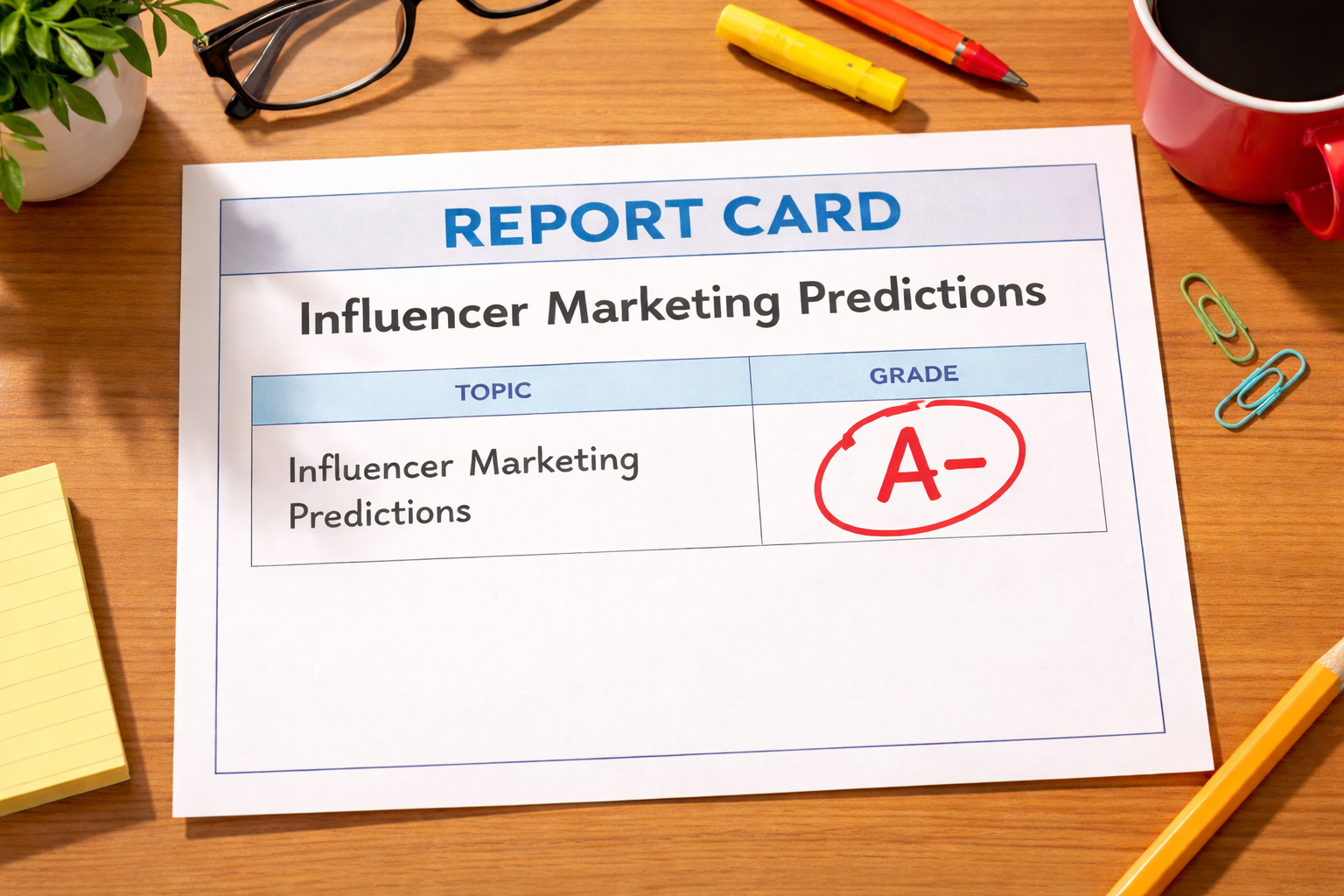
Overall Grade: A-
Taken together, these predictions held up extremely well. The big themes, such as hyperlocal influence, Gen Z’s growing cultural power, and the rise of curated content, played out exactly as expected. Other areas, including cross-platform posting and TikTok Shop, unfolded in more complex ways. The instincts were right, but the real-world dynamics were a bit messier, more nuanced, and occasionally surprising.
Danielle
P.S. Did you miss our 2026 predictions that went out last week? Check them out here.